This post has already been read at least 11358 times!
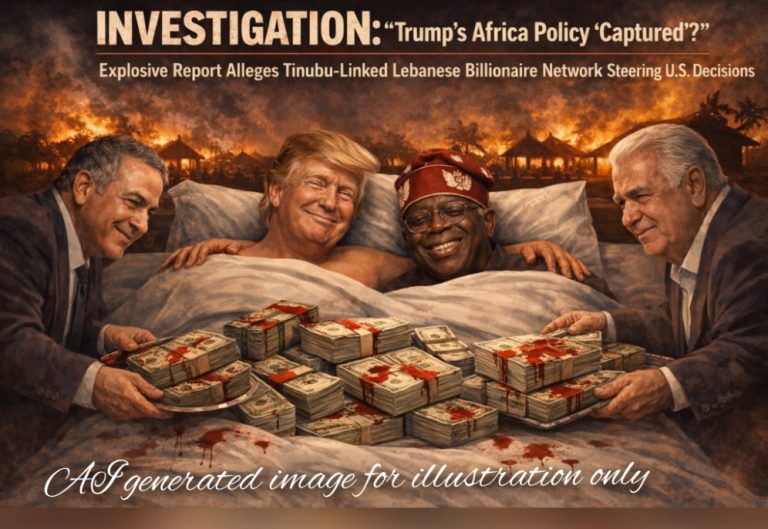
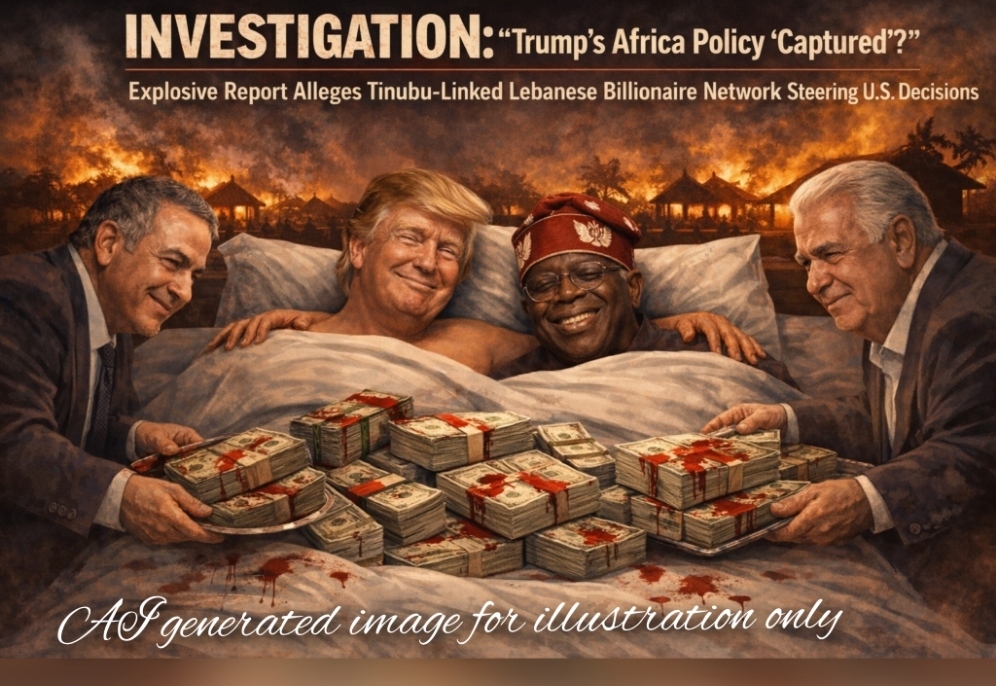
A far-reaching and highly controversial investigative report by former United States mayor and bestselling author Mike Arnold has sent shockwaves through diplomatic and political circles, alleging that United States Africa policy under President Donald Trump is being shaped by a powerful Lebanese-Nigerian business network deeply embedded in Nigeria’s political and economic structure and closely aligned with President Bola Ahmed Tinubu.
The report, published April 11, 2026, under the title “In Bed with Tinubu: The Lebanese Billionaire Network Advising Trump’s Nigeria Policy,” is described by its author as an “EarthShaker Exclusive Investigation” and presents what he calls a documented web of relationships connecting Trump’s Senior Advisor for Africa, Massad Boulos, to Lebanese-Nigerian billionaire Gilbert Chagoury, a long-time associate and major government contractor under Tinubu.
Arnold asserts that Boulos, who is also the father-in-law of Tiffany Trump and who spent three decades in Lagos as Chief Executive Officer of SCOA Nigeria PLC, “knows Nigeria’s commercial elite the way a man knows his own backyard.” He emphasizes that Boulos holds multiple citizenships, including Nigerian, and has operated within the same Lagos commercial ecosystem for thirty years.
Central to the report is the claim that Boulos has a documented business relationship with Chagoury, whose construction empire has benefited from more than $13 billion in no-bid government contracts under Tinubu’s administration.
According to Arnold, Boulos’s own corporate defense statements confirm that his company supplies equipment to Chagoury’s construction arm, thereby establishing what he describes as a direct financial linkage between a U.S. policy advisor and a primary beneficiary of Nigerian government contracts.
“This is not allegation,” Arnold states in the report. “It is in Boulos’s own corporate defense statement — published by his own people, in his own defense, after his Trump appointment.” He argues that this relationship creates a fundamental conflict of interest, asserting that “Trump is getting Africa policy advice from a man whose business clients need Tinubu in power — and whose financial relationships in Lagos give him every reason to make sure Washington looks the other way.”
The report further alleges that Boulos publicly reinforced narratives that downplay religiously motivated violence in Nigeria following a private meeting with Tinubu in Rome.
Arnold quotes Boulos’s October 17, 2025 appearance on Nigerian Television Authority, where he stated that terrorism in Nigeria “has no colour, no religion and no tribe,” adding that Boko Haram and ISIS are killing more Muslims than Christians. Arnold claims familiarity with these talking points, alleging they were part of a coordinated messaging framework he personally encountered during a controversial visit to Nigeria.
Recounting that visit, Arnold states that on October 14, 2025, he was flown to Abuja by the Nigerian government, which he claims expected him to serve as “a useful American voice — Jane Fonda in Vietnam, Nigeria edition.”
He asserts that he was placed in a controlled media setting alongside northern Islamic clerics, including Isa Pantami, and presented with pre-approved talking points.
According to Arnold, he deliberately resisted the effort, even recounting that he subtly disrupted a staged photo opportunity. He claims that during a subsequent press conference before international media, he defied expectations by delivering what he described as an indictment of “calculated genocide” rather than the anticipated denial narrative.
Arnold writes that he had been warned by trusted advisors that his actions could endanger his life, prompting him to update his will before traveling. He further claims that within seventy-two hours of his statements, the story generated 3.2 billion global impressions and dramatically shifted international perception of the crisis in Nigeria. Within that same period, he notes, Boulos held an unannounced private meeting with Tinubu in Rome and then appeared on Nigerian state television delivering what Arnold characterizes as the same talking points he had rejected.
The investigation devotes significant attention to profiling both Boulos and Chagoury, emphasizing their shared Lebanese heritage, Nigerian citizenship, and decades-long presence in Lagos’s tightly interconnected commercial and political environment.
Arnold describes this network as the very sphere in which Tinubu built his political machinery and consolidated influence, asserting that the relationships are longstanding and deeply embedded rather than incidental.
Chagoury’s record is presented as a central pillar of the report’s argument. Arnold describes it as “extensive, public, and damning,” citing a 2000 Swiss conviction for money laundering linked to funds transferred from Nigeria’s Central Bank under former military ruler Sani Abacha.
He also references Chagoury’s past inclusion on a U.S. terrorism watch list over alleged financial links to Hezbollah and a 2018 settlement with the U.S. Department of Justice involving illegal campaign contributions. Despite this history, Arnold notes that Chagoury continues to secure some of Nigeria’s largest infrastructure contracts under Tinubu, including the Lagos-Calabar Coastal Highway, port rehabilitation projects, and long-term concessions such as the Snake Island terminal.
He further highlights the quiet conferment of one of Nigeria’s highest national honors on Chagoury in January 2026, describing the process as lacking transparency.
According to Arnold, the Chagoury-Tinubu relationship dates back to at least 1999 and includes significant decisions such as the allocation of 10 million square meters of Lagos coastline, which later became Eko Atlantic City.
He asserts that Boulos’s company supplies the equipment that enables many of these large-scale developments, describing the arrangement as a documented chain of financial and political interdependence.
The report also advances the claim that this network has cultivated influence across both major U.S. political parties. Arnold points to Chagoury’s substantial donations to the Clinton Foundation and interactions with State Department officials during the tenure of Hillary Clinton, raising questions about whether such relationships may have influenced delays in designating Boko Haram as a foreign terrorist organization.
He contrasts this with the present Republican connection through Boulos, whose familial ties to Trump position him within the current administration’s inner circle. Arnold characterizes the network as “not partisan” but “transactional,” arguing that it has shaped American policy on Nigeria for decades.
A significant portion of the report focuses on concerns regarding transparency and legal compliance, particularly the requirement under U.S. law for senior officials to file financial disclosures.
Arnold notes that Boulos was required to submit such disclosures but claims that the relevant White House portal was taken offline, leaving the public unable to verify whether his business relationships were properly disclosed. “That is not a technicality,” Arnold asserts. “That is the ballgame.”
In its concluding sections, the report calls for immediate action, including the public release of Boulos’s financial disclosures, congressional investigations into past policy decisions, and the publication of pending FBI and DEA files related to Tinubu.
Arnold argues that the credibility of U.S. policy toward Nigeria depends on these disclosures and warns that failure to address potential conflicts of interest could have significant geopolitical consequences.
He concludes with a stark warning that the integrity of U.S. foreign policy may be compromised if advisory roles are influenced by undisclosed financial ties, stating that “none of it matters if the man whispering in his ear is in business with the man those moves are supposed to hold accountable.”
As the report continues to generate intense debate, its allegations remain unverified but deeply consequential, raising urgent questions about governance, accountability, and the intersection of global business and political power.
This post has already been read at least 11358 times!
About the Author

Discover more from The Street Reporters Newspaper
Subscribe to get the latest posts sent to your email.